If you have been in SEO for more than a few years, you already know one thing: search never stays the same. We have observed changes in algorithms, mobile-first indexing, featured snippets, and voice search. We are currently observing another significant change: AI-based solutions.
When users ask questions in tools like ChatGPT, Google’s AI Overviews, or other big language models, they do not have to go through 10 blue links. They are getting direct answers. And those answers are being generated from content across the web. That is where generative engine optimization comes in.
In this blog, we will break down what generative engine optimization really is, how it differs from traditional SEO, and why your agency cannot afford to ignore it. We will also share how we approach generative engine optimization services and how AEO Services fit into this new search behavior.
What is Generative Engine Optimization GEO
Generative engine optimization is the process of optimizing your content so it becomes a trusted source for AI-powered search engines and large language models that generate direct answers.
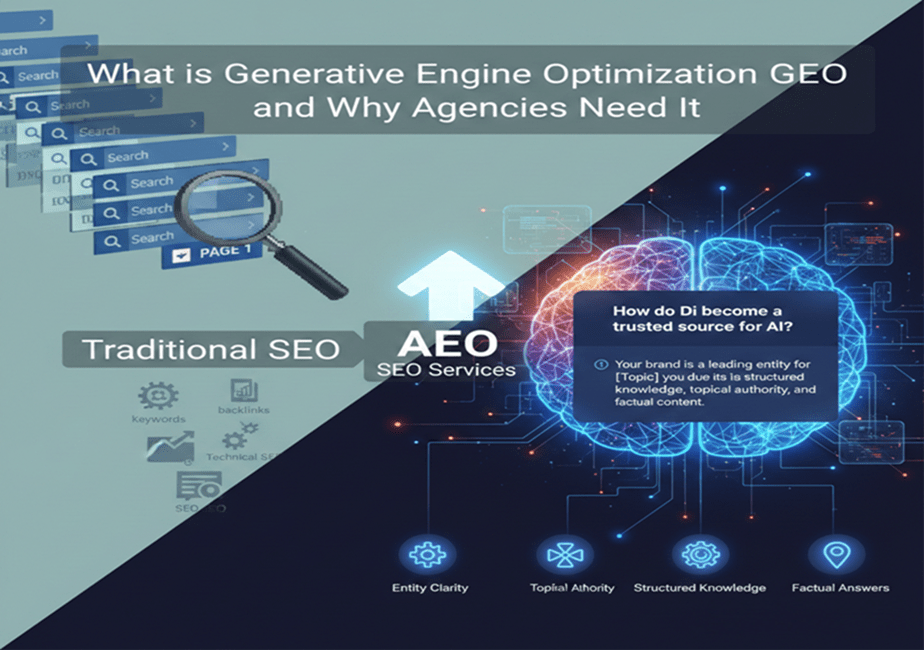
In traditional SEO, your goal was to rank on page one.
In generative engine optimization, your goal is to become part of the answer.
Instead of asking, “How do I rank number one?” you start asking, “How do I become the source that AI systems rely on when they generate responses?”
From our experience working with agencies, we noticed something important. Traffic patterns are changing. Some informational queries no longer drive the same clicks because AI tools summarize answers directly on the results page.
If your brand is not referenced or used as a source in these AI-generated responses, you are invisible in a growing portion of search behavior.
That is the core idea behind generative engine optimization.
How GEO Is Different from Traditional SEO
We believe many agencies make the mistake of thinking GEO is just “SEO with AI keywords.” It is not.
Here are the major differences we have observed:
Traditional SEO concentrates on:
- Search volume and keywords
- Backlinks
- On-page structure
- Technical performance
- Ranking positions
Generative Engine Optimization Focuses on:
- Entity clarity
- Structured knowledge
- Topical authority
- Clear, factual, well-supported answers
- Contextual depth across content clusters
When we explored this method in one of our most recent projects, we found that material prepared solely for rankings struggled to appear in AI-powered summaries. Nonetheless, generative replies were more likely to quote or paraphrase literature grounded in well-defined expertise, organized facts, and robust thematic coverage.
That shift changed how we think about content planning.
Why Agencies Cannot Ignore Generative Engine Optimization
You may be wondering, “Is this really necessary right now?”
From what we are seeing, the answer is yes.
Here is why.
- Search Behavior Is Changing Fast
Users are asking more complex questions. “Which CRM is best for a small real estate team under 10 agents?” is what customers are putting in place of “best CRM tools.”
AI systems respond with structured answers. If your content does not clearly address detailed, intent-driven questions, you are not part of that conversation.
We have seen clients lose clicks on broad informational terms but gain visibility when their content was structured to answer layered questions.
- Authority Matters More Than Ever
AI systems prioritize trustworthy sources. They look at consistency, expertise signals, and how well a topic is covered across a domain.
This is where generative engine optimization services become essential for agencies managing multiple clients. You cannot rely only on keywords anymore. You must build topical ecosystems.
We believe agencies that adapt early will position themselves as leaders in this shift.
- Clients Are Already Asking About AI Visibility
In the past year, we have seen more agencies ask us:
- “How do we show up in AI answers?”
- “How do we track visibility in ChatGPT or AI Overviews?”
- “Is traditional SEO enough?”
If you are not prepared to answer these questions, your competitors will be.
Where AEO Services Fit Into GEO
AEO stands for Answer Engine Optimization. It focuses on structuring content to answer user queries directly in search engines and voice assistants.
You can think of AEO as a foundational layer of generative engine optimization.
When we provide AEO SEO services, we focus on:
- Clear question-based content
- Schema markup
- FAQ structures
- Conversational formatting
- Direct, concise answers supported by deeper context
In one of our recent collaborations with an agency partner, we restructured long-form blogs into layered answer sections. We used semantic structure to clearly show important information rather than burying it deep within the page.
We saw improved presence in AI-generated summaries and better performance in highlighted snippets in just a couple of weeks.
AEO Services helps your content become easy to extract, interpret, and summarize. That is exactly what generative systems need.
How We Approach Generative Engine Optimization Services
At Digital Agency Reseller, we see generative engine optimization as a strategic layer built on strong SEO fundamentals.
Here is how we typically approach it with our agency partners.
Build Entity Authority
We make sure your brand and your client’s brand are clearly defined entities. That means consistent branding, structured data, author credibility, and strong pages.
AI systems connect entities, not just keywords.
Create Topic Depth Instead of Thin Pages
Instead of producing dozens of surface-level blogs, we focus on deep topic clusters. Each core page is supported by detailed subtopics that fully address user intent.
When we shifted one client from scattered blog topics to tightly structured clusters, we noticed improved visibility not only in organic search but also in AI summaries.
Structure Content for Machine Understanding
We pay close attention to formatting:
- Clear headings
- Logical flow
- Direct answers
- Supporting data
- Context expansion
Generative systems need clarity. Your content is less likely to be considered as a reliable source if it is unclear, ambiguous, or too promotional.
Align With Conversational Queries
We analyze how users ask questions in real-world scenarios. AI queries are often conversational. So your content should reflect how people actually speak and search.
That is where AEO SEO services and generative engine optimization work together.
The Risk of Ignoring GEO
Let us be honest.
If your agency continues offering only traditional SEO without adapting to generative engine optimization, you may face:
- Declining informational traffic
- Reduced perceived expertise
- Clients questioning your strategy
- Competitors are pitching “AI visibility” services.
We believe the agencies that treat GEO as optional are taking a short-term view.
In our conversations with partners, we often say: SEO is no longer just about rankings. It is about presence across all search surfaces.
Generative engines are one such surface.
How to Begin Adapting Right Now
- Audit your top informational pages. Are they structured clearly with direct answers?
- Strengthen your topic clusters. Are you covering subjects deeply or just skimming them?
- Add structured data wherever relevant.
- Review author bios and expertise signals.
- Think beyond keywords and focus on intent patterns.
When you combine these steps with professional generative engine optimization services, you position your agency as forward-thinking and prepared.
Why Agencies Partner With Us for GEO and AEO SEO Services
At Digital Agency Reseller, we work behind the scenes with agencies that want to scale without building large in-house teams.
We understand the pressure you face. Clients expect results. They expect innovation. And now they expect AI visibility.
Our approach to generative engine optimization and AEO Services is built on real testing, data analysis, and collaboration with agency partners across industries.
We do not treat GEO as a trend. We treat it as the next stage of search.
When you partner with us, you can confidently offer generative engine optimization services and AEO SEO services under your brand while we handle the strategy and execution.
Final Thoughts
Search is not disappearing. It is evolving. Generative engine optimization is about ensuring your content isn’t just ranked but also referenced, trusted, and used in AI-driven answers.
Early adaptation, in our opinion, will provide agencies a competitive advantage in terms of authority, visibility, and client retention. You don’t have to give up on traditional SEO. You must broaden your approach.
If you’re ready to position your agency for the next phase of search, it’s time to really consider generative engine optimization. We are also available to help if you require a partner who is knowledgeable in both the foundations of SEO and AI-driven search behavior.